
Chinese Nanny: Mandarin and Cantonese Childcare Matched to Your Family
Chinese Nanny Placement for Mandarin & Cantonese Immersion — matched, vetted, and placed by people who have done this since 2011.
Background-Checked & Vetted
1,000+ Families Served
Since 2011
Replacement Guarantee

What Is a Chinese Nanny?
A Chinese nanny is a professional caregiver who speaks Mandarin or Cantonese and provides daily childcare — live-in or full-time — while passing on language, food, and cultural habits. Unlike a postpartum nanny, who focuses on newborn and maternal recovery, a Chinese nanny supports children through the ongoing years of growing up.
Most families who call us about a Chinese nanny want two things at once: dependable, hands-on care, and a home where their child keeps hearing the language their grandparents speak. That second part is harder to buy than it sounds. A nanny who happens to speak Mandarin is not the same as a nanny who can read bedtime stories in it, cook the food a child grew up with, and hold a household to the standards a Chinese-American family expects. This page explains how the two differ, what the role actually covers, what it costs, and how we match families with the right person.
What a Chinese Nanny Does — and How It Differs From Postpartum Care
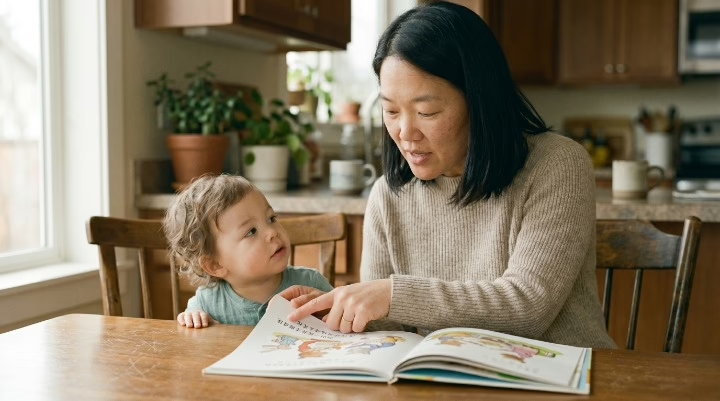
A Chinese nanny runs the everyday rhythm of a child’s life. That means meals, naps, school pickups, homework, play, and the hundred small decisions a parent makes when they are home. The job is ongoing — families typically bring one on for a year or longer, often from infancy through the early school years.
This is a different role from the two postpartum services families sometimes confuse it with. A Chinese postpartum nanny (yue sao) moves in for the recovery window after birth — usually 26 to 40 days — and her focus is the mother’s healing and round-the-clock newborn care. A confinement nanny follows the traditions of zuo yue zi during that same short window. A Chinese nanny picks up where those leave off and stays for the long haul.
The day-to-day looks like this:
- Language every waking hour. The nanny speaks Mandarin or Cantonese with the child by default — not as a lesson, but as the language of the house. Children absorb a heritage language when it is simply how care happens.
- Cooking from scratch. Congee, dumplings, steamed fish, vegetables the way a child’s family eats them. Food is one of the strongest carriers of culture, and it is one of the first things parents tell us they miss when a nanny does not share their background.
- Routine and developmental support. Sleep schedules, potty training, reading, early academics, and the patient repetition young children need.
- Light household care tied to the child. The child’s laundry, tidying play areas, meal prep, and keeping the nursery or bedroom in order.
Key Takeaway
A postpartum nanny is for the weeks after birth. A Chinese nanny is for the years that follow — language, food, and daily care as your child grows.
Why Families Hire a Chinese-Speaking Nanny
The reason families give us most often is the one that is hardest to solve any other way: they want their child to grow up actually speaking the language, not studying it on weekends. A child who hears Mandarin or Cantonese all day from someone they love learns it the way every first language is learned — without flashcards. Research from the American Academy of Pediatrics is clear that early, consistent exposure is what builds real fluency in a second language, and that young children are more than capable of holding two languages at once.
There is also the matter of who the child is being raised by. Chinese is the third most-spoken language in U.S. homes after English and Spanish, according to U.S. Census Bureau data, and the families we serve are usually first- or second-generation. They want a caregiver who understands why shoes come off at the door, why a fever is met with warm water rather than ice, and why grandparents have a say. A nanny who shares that background does not need any of it explained.
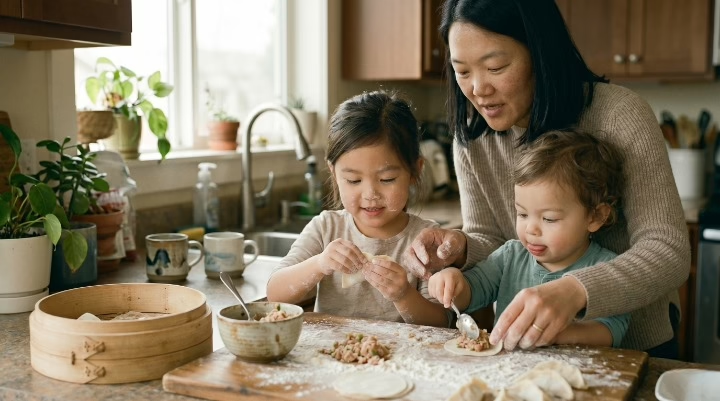
What families tell us they get from the right match:
- A child who answers in Chinese. Not perfect grammar at age three — but the instinct to use the language, which is the part that fades without daily exposure.
- Cultural continuity grandparents recognize. Manners, holidays, and food that connect three generations even when the grandparents live overseas.
- Care that matches the household. Expectations around cleanliness, study habits, and respect that a family does not have to teach from scratch.
- One steady person. The same caregiver for years, which matters more for a young child than almost any other variable.
What a Good Match Looks Like: A Bay Area Example
A typical case looks like this. Two working parents in the Bay Area, both fluent in Mandarin but speaking English all day at the office, watch their two-year-old start answering them only in English. They are not after a tutor — they want their daughter to keep the language without it becoming a chore for anyone. We place a live-in nanny from Taiwan who speaks Mandarin with the child all day and cooks the food the grandparents make. Within a few months the toddler is switching between languages on her own. Nothing about that outcome is unusual; it is simply what daily exposure from a trusted adult produces.
Mandarin-Speaking or Cantonese-Speaking Nanny? Choosing the Right Match
The single most important detail in a Chinese nanny search is which language you want spoken at home. Mandarin and Cantonese are not interchangeable, and a child raised on one will not pick up the other by accident. Tell us which one matters, and we match for it specifically.
Mandarin is the right choice for most mainland Chinese and Taiwanese families, and for parents who want their child connected to the language used across most of greater China and in Chinese schools in the U.S. Cantonese matters deeply to families with roots in Hong Kong, Guangdong, and many older Chinatown communities, where it is the language of the grandparents and the family table. Neither is “better” — they are simply different households, and the wrong dialect quietly defeats the entire purpose of the hire.
| Mandarin-speaking nanny | Cantonese-speaking nanny | |
|---|---|---|
| Usually the right match for | Families from mainland China or Taiwan, and parents who want the language taught in most U.S. Chinese schools | Families with roots in Hong Kong, Guangdong or an older Chinatown community |
| Characters your child learns to read | Simplified (mainland) or Traditional (Taiwan) | Traditional |
| Confirm during matching | Accent preference, and reading and writing ability if you want homework help | Whether grandparents speak a related dialect such as Toishanese |
A few things we sort out during matching:
- Spoken vs. literacy. If you want homework and reading support, we confirm the nanny can read and write Chinese characters, not only speak. Spoken fluency and literacy are separate skills.
- Accent and region. Some families prefer a standard Mandarin accent for clarity; others want the regional accent their own family speaks. Both are findable.
- English alongside Chinese. Many of our caregivers also speak English, which helps with school communication and pediatrician visits while still keeping the child’s day in Chinese.
If your household speaks both — say, Cantonese with grandparents and Mandarin at school — tell us your priority. We have placed nannies who carry both, though it narrows the pool, and we will be straight with you about the trade-off rather than promise a unicorn.
Chinese Live-In vs. Full-Time Day Nanny: Which Fits Your Home?
The first practical decision is whether your nanny lives with you or comes daily. Both are common, and the right answer depends on your space, your hours, and how much overnight help you need. Here is how the two compare.
| Factor | Live-In Chinese Nanny | Full-Time Day Nanny |
|---|---|---|
| Hours | Lives in the home; available across the day with scheduled time off | Set daily shift, typically 9–11 hours |
| Overnight help | Yes, when arranged | No — goes home after shift |
| Space needed | A private bedroom (bathroom preferred) | None |
| Language immersion | Highest — the child hears the language morning to night | Strong during the workday |
| Best for | Long hours, frequent travel, or two working parents who want overnight coverage | Families with the room for a daytime routine and their own evenings |
A live-in arrangement gives the deepest language exposure simply because the child hears Mandarin or Cantonese from breakfast through bedtime. A day nanny still delivers strong immersion across working hours and suits families who would rather keep the house to themselves in the evening. We help you decide during matching, and the choice is reversible — many families start with one and adjust as their needs change.
How We Vet and Match Chinese Nannies
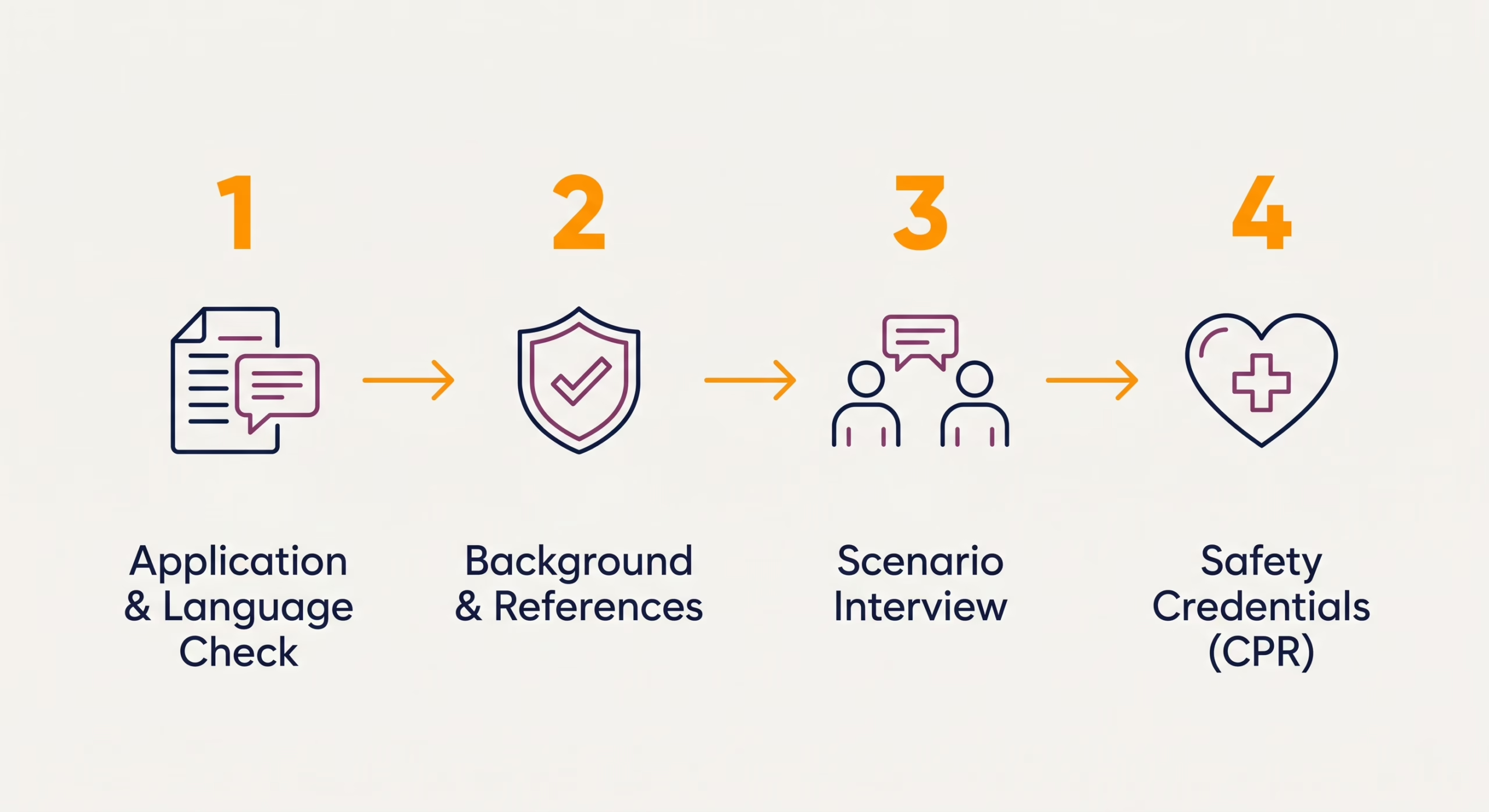
In our years of placing caregivers, the difference between a good year and a hard one almost always traces back to screening. A nanny who looks fine on paper can still be the wrong fit for a family’s pace, standards, or child. So we built the process to surface that early, before anyone signs.
1
Application and language check
We confirm spoken fluency in Mandarin or Cantonese — and, where families ask for it, reading and writing ability for homework support.
2
Background and reference verification
Identity, work history, and direct calls to prior families. Childcare is not a field where references get skipped.
3
In-depth interview
We talk through real scenarios — a sick day, a tantrum, a picky eater, a safety call — to see how a candidate actually thinks, not how she rehearses.
4
Safety credentials
We look for current CPR and first-aid training; the American Red Cross offers the certification we point candidates toward when it needs renewing.
Only after that do we match. We weigh the things that make a placement last: the age of your child, your household language, your standards around food and cleanliness, your hours, and the personality that will fit your home. You interview the candidates we present, you make the final call, and if the fit is not right, your placement is covered by our 60–90 day replacement guarantee. For families who want to see the full sequence, our step-by-step matching process lays it out in detail.
A Note on Safety
Ask any agency or independent candidate for proof of current CPR and first-aid certification and the date of their last background check. A caregiver responsible for your child should be able to show both without hesitation.
What a Chinese Nanny Costs
Cost is usually the second question, right after language. A full-time or live-in Chinese nanny in the U.S. generally runs $170 to $320 per day: $170–$300 in Southern California, $220–$320 in Northern California, and $220–$300 outside California. Within a band, the figure is driven by the hours, the number of children, and whether you need overnight or travel coverage. Native fluency and strong references sit at the higher end of that band, because they are the hardest combination to find.
A few things shape where your placement lands:
- Region. The band is set by region, not by city: every Southern California placement uses the $170–$300 band, whether the family is in Irvine or Pasadena, and every Northern California placement uses $220–$320.
- Live-in vs. day. Live-in rates account for room and board; day rates account for the commute and fixed shift.
- Scope. One child versus three, light housekeeping tied to the child, and any overnight or weekend needs.
It helps to separate two numbers. The nanny’s pay is the daily or weekly wage above, and it goes to the caregiver. The agency placement fee is what you pay us, once, to screen, match, and stand behind the placement with the replacement guarantee. We tell you both before you commit — there are no surprise charges after matching. For current rates by service and region, see our nanny salaries and rates guide, which breaks the numbers down with regional ranges.
One more cost worth naming: the cost of getting it wrong. A placement that falls apart at month three means re-interviewing, retraining, and a child adjusting to yet another adult — which is exactly what the screening and the guarantee are built to prevent. Paying a little more for a vetted, well-matched nanny is usually cheaper than the churn of a bargain hire that does not last.
Find Your Chinese Nanny
Tell us which language your household speaks, your schedule and your child’s age, and we will match you with a vetted Mandarin- or Cantonese-speaking nanny.
Background-checked candidates · Replacement guarantee · Nationwide placement since 2011
Chinese Nanny Near Me: Where We Place
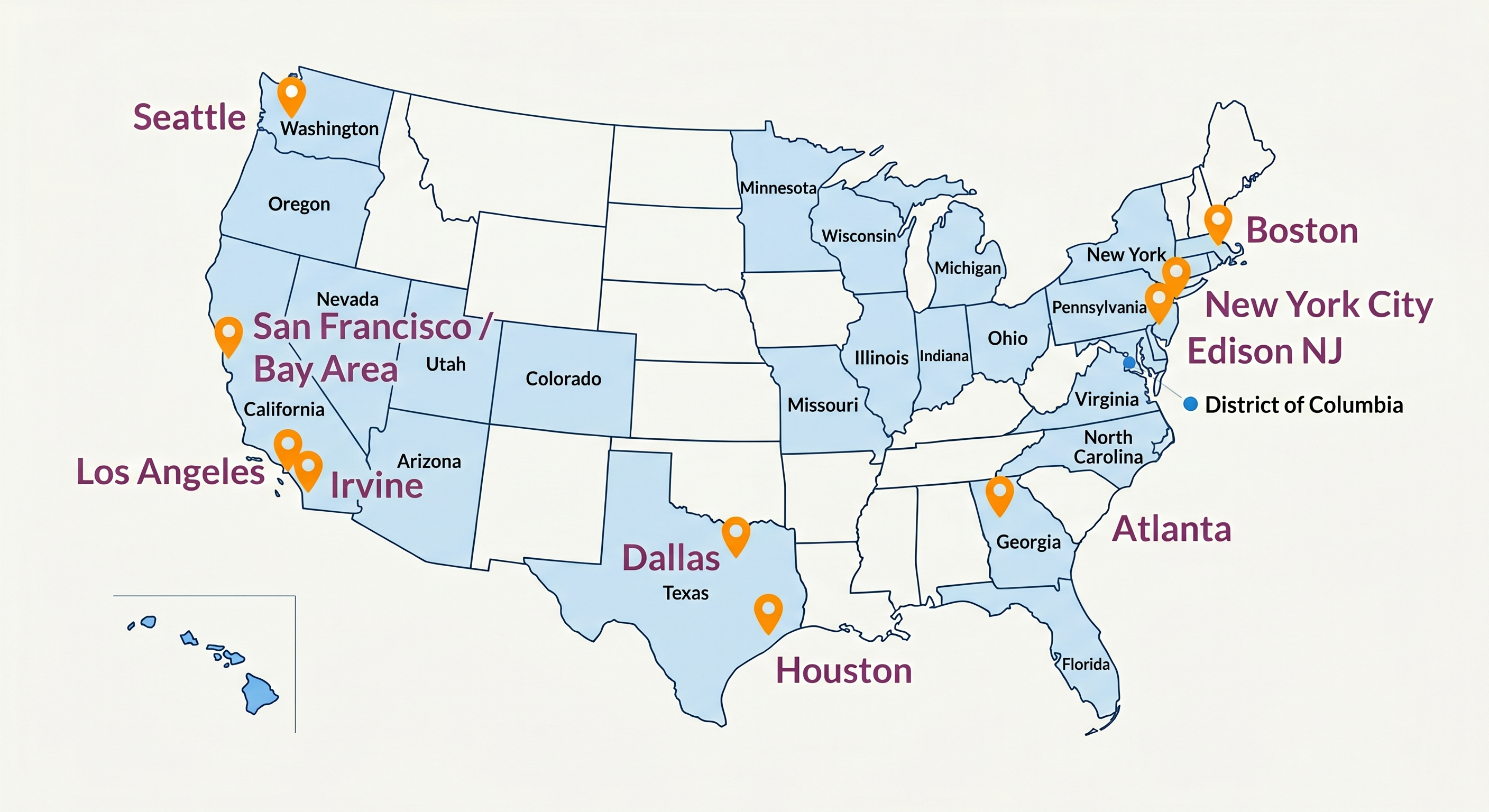
We place Chinese nannies nationwide, with the deepest pools in the metros where Chinese-American families cluster. If your city is listed below, you can read about availability and local demand on its own page; if it is not, we very likely still serve it — most placements are arranged remotely and the nanny relocates or commutes.
- California: San Francisco & the Bay Area, Los Angeles, Irvine
- New York & New Jersey: New York City, Edison
- Texas: Dallas, Houston
- Washington & beyond: Seattle, Boston, Atlanta
Live-in nannies can be placed anywhere in the country. A live-out day nanny depends on how many Chinese-speaking caregivers live within commuting distance, so tell us your ZIP code early.
Looking for newborn-specific help instead? If your child is days or weeks old, a Chinese postpartum nanny or night nurse is the better starting point, and many families move from one of those into a long-term Chinese nanny when the recovery window ends.
Common Mistakes Families Make When Hiring a Chinese Nanny
After more than a decade of placements, the same avoidable missteps come up again and again. Knowing them ahead of time saves families a hard restart.
- Hiring for language alone. A nanny who speaks Mandarin but is impatient with a toddler is still the wrong hire. Language is the reason you start the search; temperament, reliability, and judgment are what make the placement last.
- Skipping the dialect conversation. Assuming “Chinese” is one language leads to a Cantonese-speaking household ending up with a Mandarin-only nanny. Name the dialect first, before anything else.
- Treating the nanny as a language tutor. The value is immersion through daily life, not drills. Families who micromanage the “lessons” tend to squeeze out the natural exposure that actually works.
- Cutting corners on screening. Hiring through a group chat or a distant relative’s recommendation skips background checks and references. For the person spending all day with your child, that is the one place not to economize.
- No written agreement. Vague expectations around hours, duties, time off, and overtime cause most early breakups. A clear agreement protects the family and the nanny, and it is part of every placement we make.
Key Takeaway
Match for temperament and reliability first, confirm the dialect second, and never skip screening or a written agreement. That order is what keeps a placement together past the first few months.
Frequently Asked Questions
What is the difference between a Chinese nanny and a Chinese postpartum nanny?
A Chinese postpartum nanny (yue sao) cares for a mother and newborn during the 26–40 day recovery window after birth, sometimes longer after a C-section. A Chinese nanny provides ongoing daily childcare — language, meals, routine, and developmental support — for months or years as a child grows. Many families use one after the other.
Will the nanny speak only Mandarin or Cantonese with my child?
That is your call. Most families ask the nanny to speak Mandarin or Cantonese by default so the child gets full immersion, while the parents handle English. We match based on the dialect you want, and many of our caregivers speak both a Chinese language and English.
How much does a Chinese nanny cost?
A live-in Chinese nanny costs $170 to $320 per day depending on region: $170–$300 in Southern California, $220–$320 in Northern California, and $220–$300 outside California. Fluent Mandarin or Cantonese alongside English can raise the rate; the nanny cost calculator estimates it by region and language. Driving and cooking for the wider household are quoted separately. Our 2026 nanny rate guide breaks down every band.
Can a Chinese nanny help with homework and reading?
Yes, when you ask for it. Some families want spoken fluency only; others want a nanny who can read and write Chinese to support homework and early literacy. We confirm reading and writing ability during screening so the match fits what you actually need.
Do you place live-in and full-time day nannies?
Both. A live-in nanny gives the deepest language immersion and overnight coverage but needs a private bedroom. A full-time day nanny works a set shift and goes home after. We help you choose during matching, and you can switch arrangements later as your family’s needs change.
How are your Chinese nannies screened?
Every candidate clears a four-step screen: an application with a language check, background and reference verification with calls to prior families, an in-depth scenario interview, and confirmation of current CPR and first-aid training. You interview the finalists and make the final decision yourself.
What if the nanny is not the right fit?
Your placement is covered by our replacement guarantee: 60 days in Southern California and 90 days everywhere else, including San Diego. If the match is not working within that window, we find you a replacement at no additional placement fee. We would rather re-match than leave a family with the wrong fit for their child.
Chinese Nanny Placement at a Glance
My Asian Nanny places vetted Chinese nannies — Mandarin- and Cantonese-speaking caregivers who provide ongoing live-in or full-time childcare with heritage-language immersion and home cooking. Distinct from postpartum or confinement care, which serve the weeks after birth, a Chinese nanny supports children for months or years. Rates run $170–$320 per day, and placements carry a 60–90 day replacement guarantee nationwide.
Ready to Find a Chinese Nanny Who Fits Your Family?
Connect with a vetted Mandarin- or Cantonese-speaking nanny matched to your family — backed by our replacement guarantee.
Prefer to talk it through? Call us at (626) 537-1191 · Serving families nationwide since 2011
What Families Say
Join 1,000+ families who have trusted My Asian Nanny since 2011.